
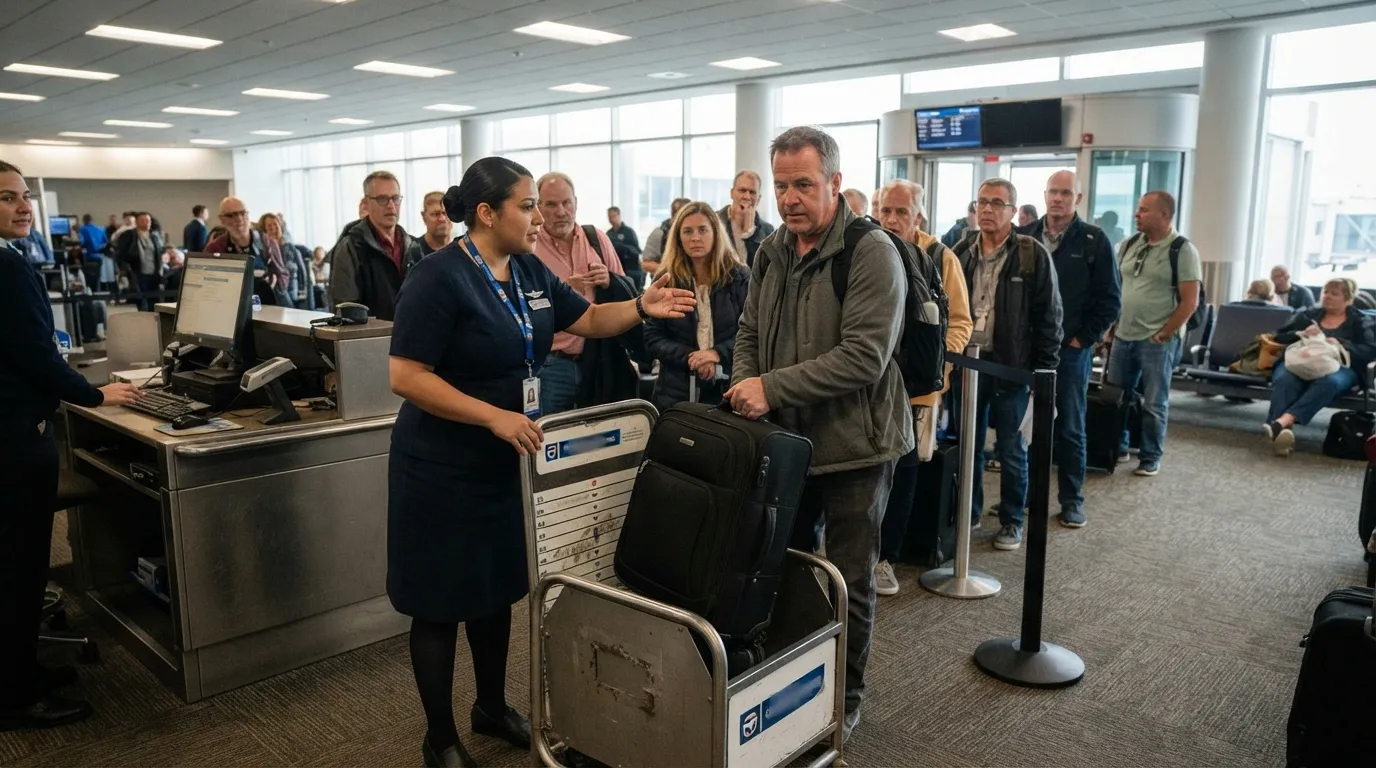
Most travelers assume the rules for carry-on bags are the same as they’ve always been – same size, same weight, same honor system that let a slightly-too-big suitcase slide through for years. That assumption is exactly what’s costing people money and boarding-gate meltdowns right now. The dimensions on paper haven’t budged, but something underneath them quietly shifted, and almost nobody noticed until they were standing at a jet bridge with a bag that suddenly “didn’t fit.”
Here’s the part that gets buried in the fine print: this isn’t really about your suitcase at all. It’s about a system airlines built to look like it’s protecting you, while doing something else entirely behind the scenes. Once you see how it actually works, you’ll never look at that little metal frame by the gate the same way again.
The Rule Nobody Told You: Your Bag Didn’t Shrink, The Enforcement Did
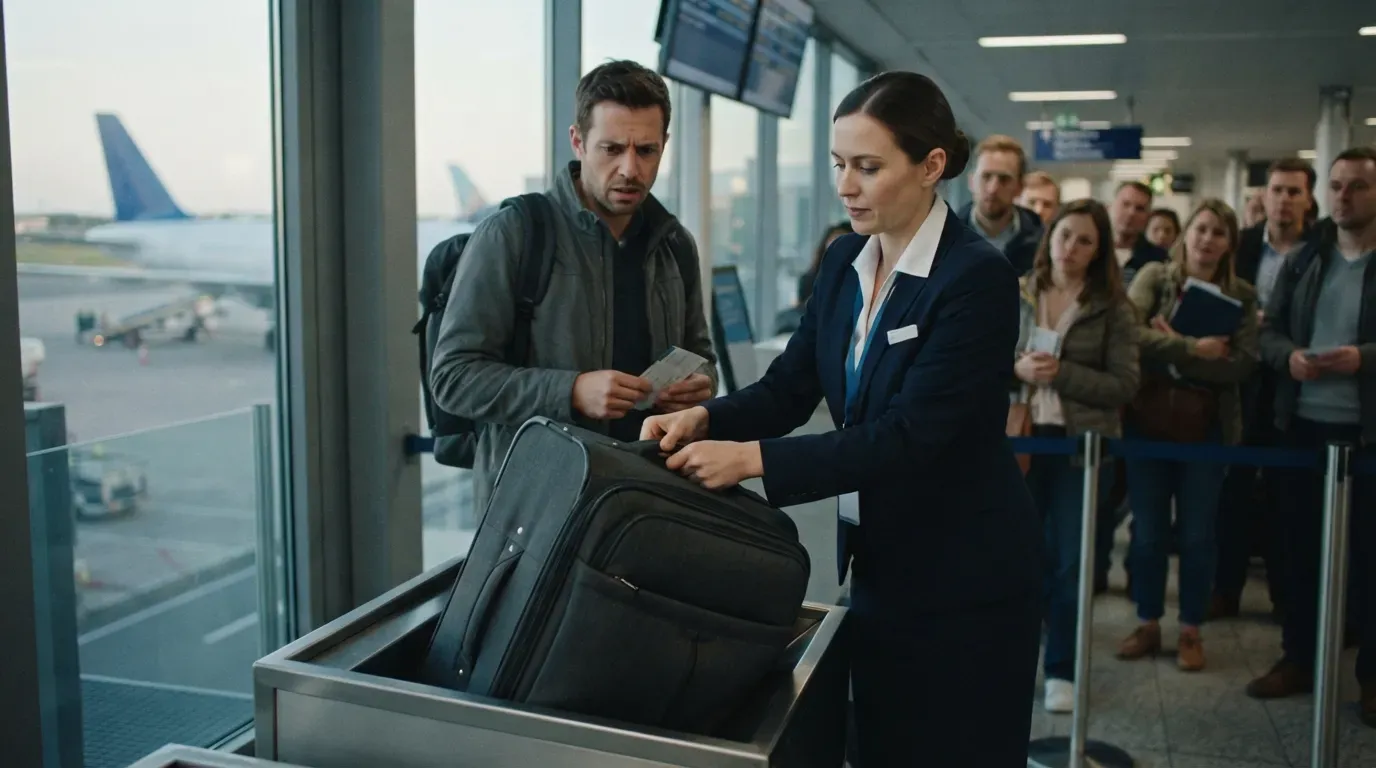
Here’s the twist most flyers miss completely: the actual size limits are the same ones airlines have used for years. Welcome to 2026, where the bag that sailed through last year might get stopped cold this year, even though nothing on the size chart moved an inch. What changed is whether anyone actually checks.
The size limits airlines publish are not new. What changed in late 2025 and into 2026 is how consistently airlines are applying them. For a decade, gate agents mostly eyeballed bags and waved people through. Now that same bag gets pulled aside, measured, and sent to the belly of the plane – no rule change required, just a sudden willingness to enforce the one that was already there.
Airports Are Quietly Installing Robots to Measure Your Bag for You
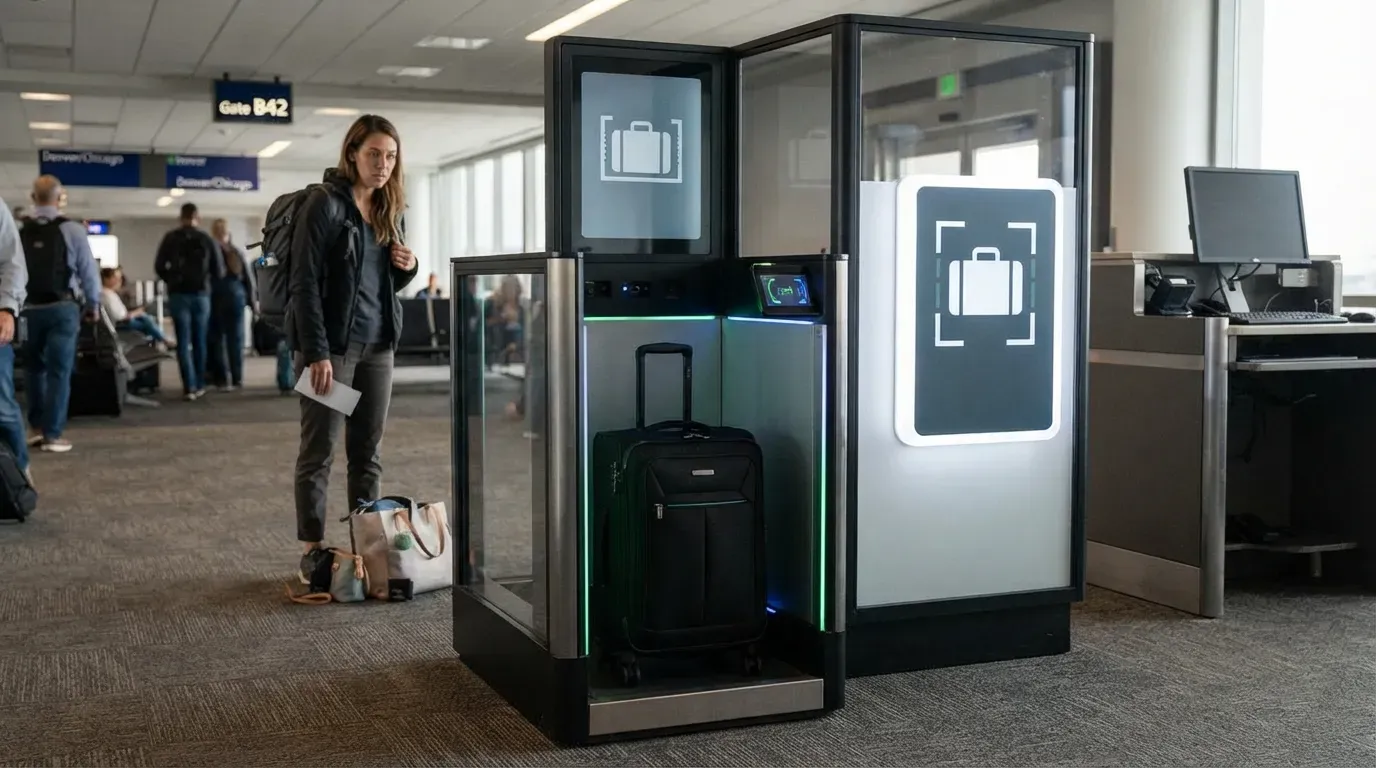
The honor system is being replaced by machines that don’t care about your excuses. United deployed automated bag sizer scanners at 35-plus airports in late 2025, and Delta and American are testing similar systems. These aren’t the old metal frames you could nudge a bag into with a little shove.
Automated bag scanners have been deployed at gate areas in a growing number of U.S. airports, measuring bag dimensions before boarding without requiring a gate agent to physically test each bag – removing the human discretion that previously allowed oversized bags to pass without challenge. United is targeting 80-plus locations by the end of 2026. Translation: the friendly agent who used to let it slide is being taken out of the equation entirely.
Fast Facts
- United’s automated sizers were live at 35+ airports by late 2025
- Target of 80+ locations nationwide by the end of 2026
- Delta and American are testing comparable scanning systems
- Scanners measure bags without any gate agent judgment call involved
The “Vanishing” Gate Sizer Stunt Wasn’t About Convenience
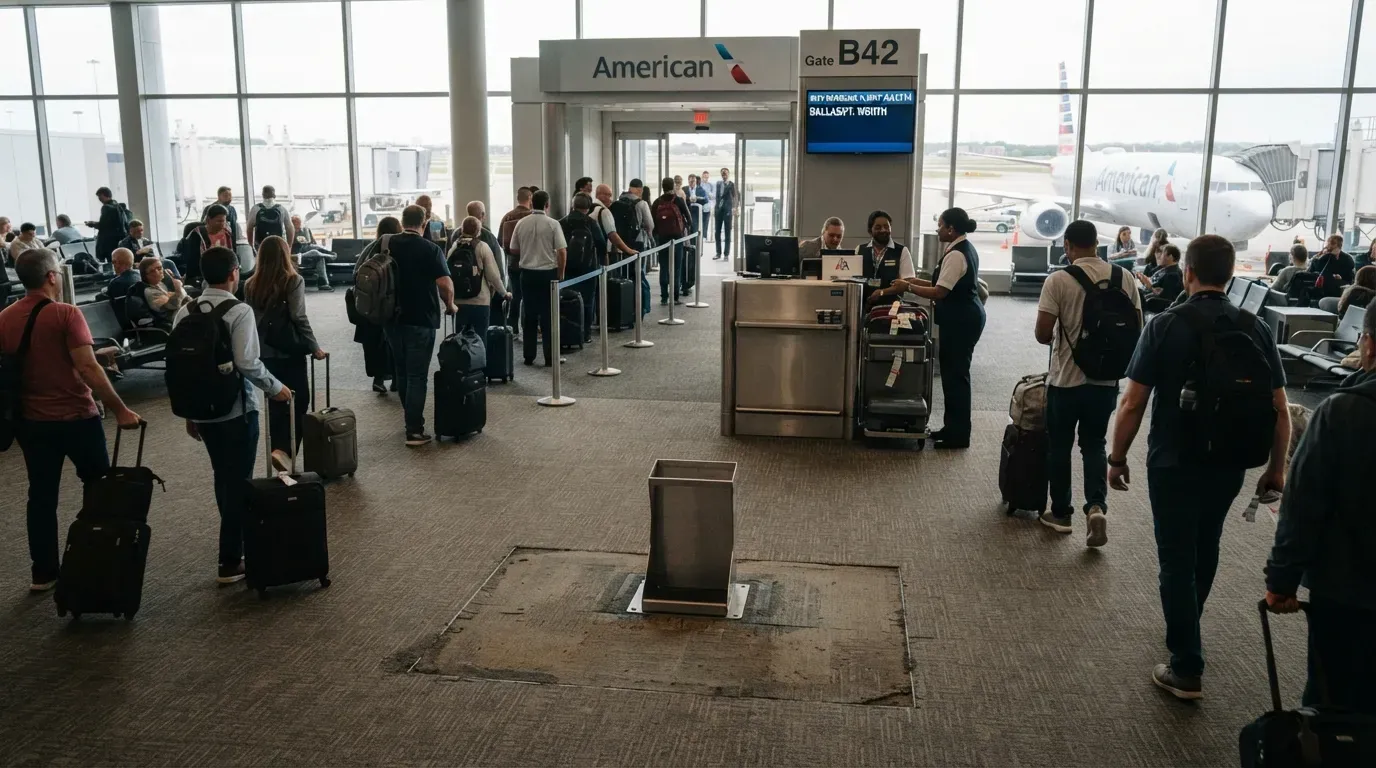
When American Airlines announced it was pulling bag sizers from its gates in October 2025, headlines framed it as a customer-friendly move. The real story is messier. American said the change would streamline boarding, since bags that looked too big previously had to go through a bottleneck while agents gate-checked the offending piece.
But the fine print matters here. American Airlines confirmed that oversized items will still be required to be checked ahead of the flight – the carry-on size limits remain the same, and losing the sizer at the gate doesn’t mean a free pass for an oversized suitcase. Meanwhile, ultra-low-cost carrier Frontier has taken the opposite approach entirely, doubling down on gate sizers instead of retiring them. That contradiction alone should tell you something about who these rules are really designed to serve.
Your Bag Passed Last Year? That Means Nothing Now
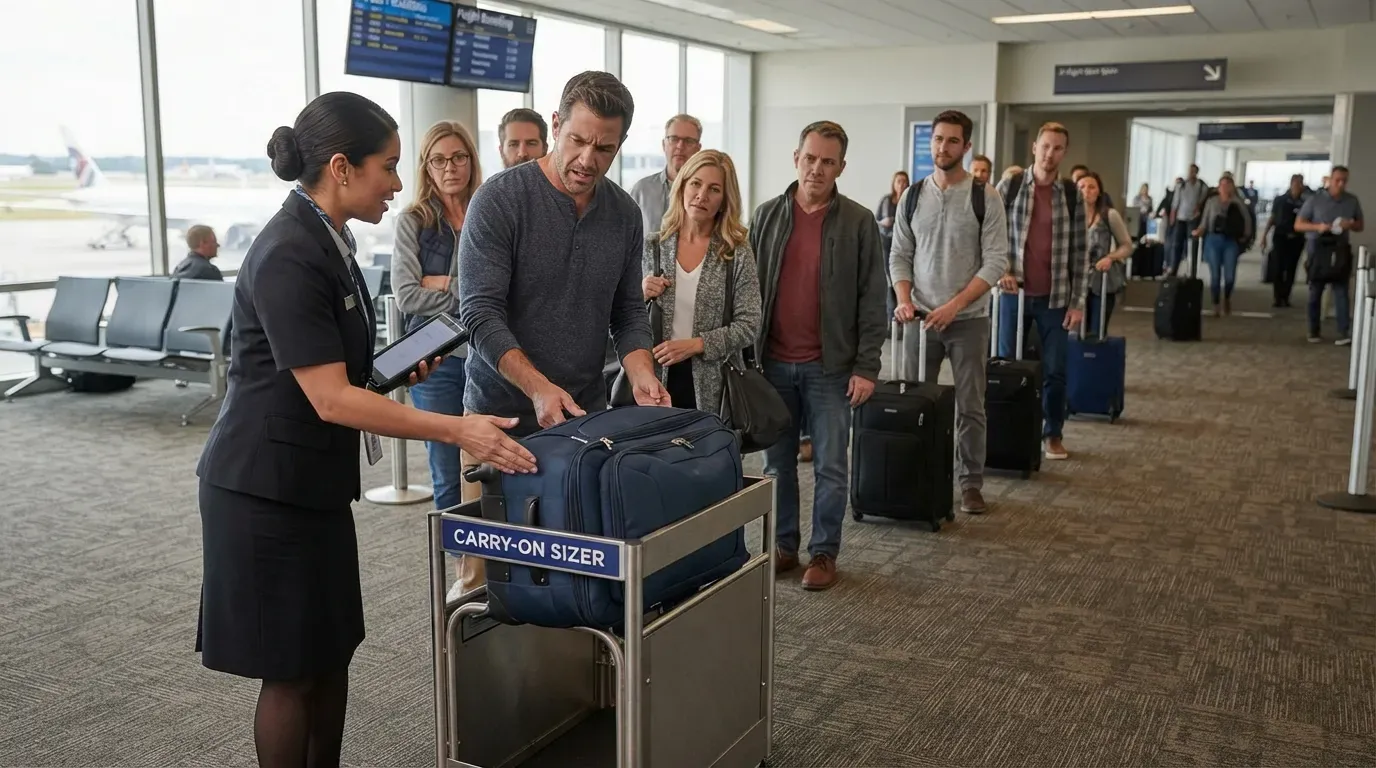
A bag that squeaked through in 2023 is not guaranteed to squeak through today, and that’s by design. Soft-sided bags used to get leeway because they could compress to fit the sizer, but that grace period ended – if a bag doesn’t fit the metal frame at the gate now, it gets checked.
Gate agents have gotten sharper at spotting the trick, too. They’ve learned to spot expanded bags quickly, since the visual cue is obvious – a bag that looks stuffed and bulges beyond its frame gets flagged for measurement even if it technically measures within limits. That “expandable” zipper pocket you’ve relied on for years? Travel experts now recommend packing expandable bags in their non-expanded configuration, because the extra space isn’t worth the gate-check fee.
Basic Economy Flyers Are the Real Test Group
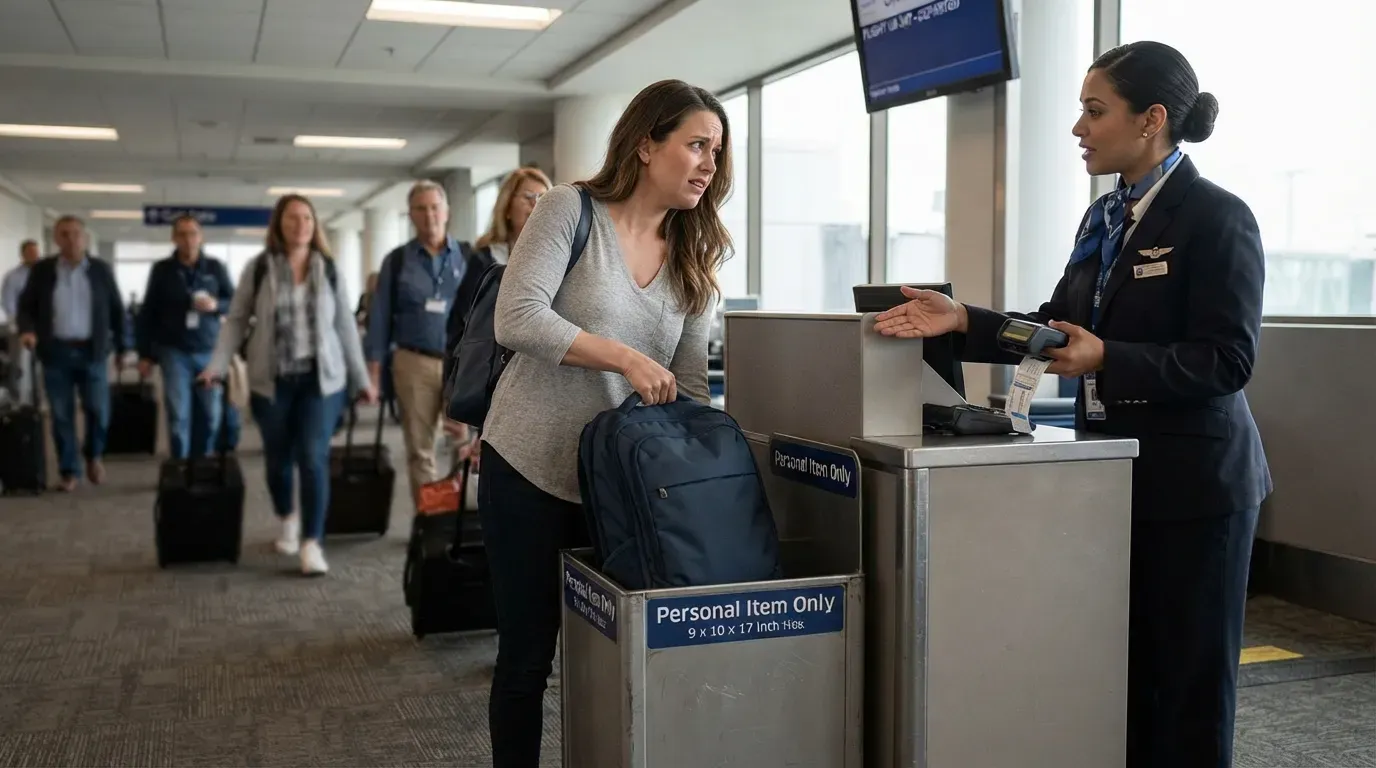
If you fly the cheapest fare class, you’re often the one absorbing the strictest version of these rules first. On United, Basic Economy passengers get one personal item only, no larger than 9 by 10 by 17 inches, unless they’re flying certain international routes. Try to sneak on a full-size bag anyway, and you’ll be required to check it with a handling fee between $35 and $65, depending on when it’s caught.
Not every airline plays it the same way, and that inconsistency is exactly the point. Alaska, American, Delta, Southwest, and United (outside domestic basic economy) all include free carry-ons plus a personal item, while JetBlue’s Blue Basic tier allows a personal item only. Ultra-low-cost carriers skip the nuance entirely: Frontier, Spirit, and Allegiant simply charge for carry-ons outright, anywhere from $45 to $100 depending on when you pay.
Quick Compare: Who Actually Gets a Free Carry-On
- Alaska, American, Delta, Southwest, United (standard fares) – free carry-on plus personal item
- United Basic Economy (domestic) – personal item only, 9x10x17 max
- JetBlue Blue Basic – personal item only, no free carry-on
- Frontier, Spirit, Allegiant – carry-ons cost $45-$100 depending on timing
One Airline Pays Gate Agents a Bonus to Catch Your Bag
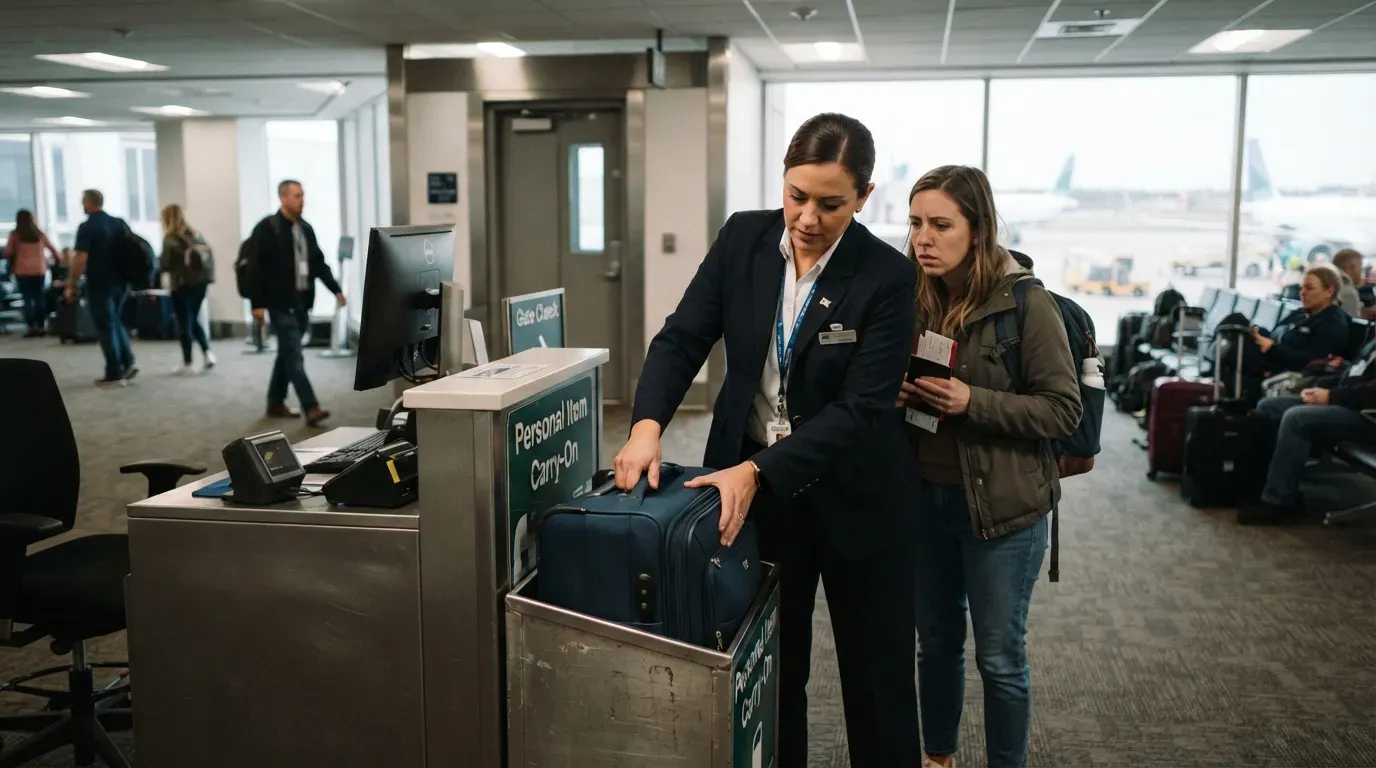
This is the detail that tends to stop people mid-scroll. Ultra-low-cost carrier Frontier has famously weaponized gate sizers by offering financial bonuses to gate agents who catch passengers with oversized personal items or un-ticketed carry-ons. That’s not a rumor – it’s a documented incentive structure built directly into how the airline staffs its gates.
Think about what that actually means in practice. An employee whose paycheck can grow based on how many bags they flag has zero reason to look the other way on a borderline suitcase. It reframes the entire “just checking for safety” narrative airlines like to use, and it’s a big reason travelers on ultra-low-cost carriers report far more aggressive bag challenges than those flying legacy carriers with salaried gate staff.
The Small Regional Jet Trap Almost Nobody Sees Coming
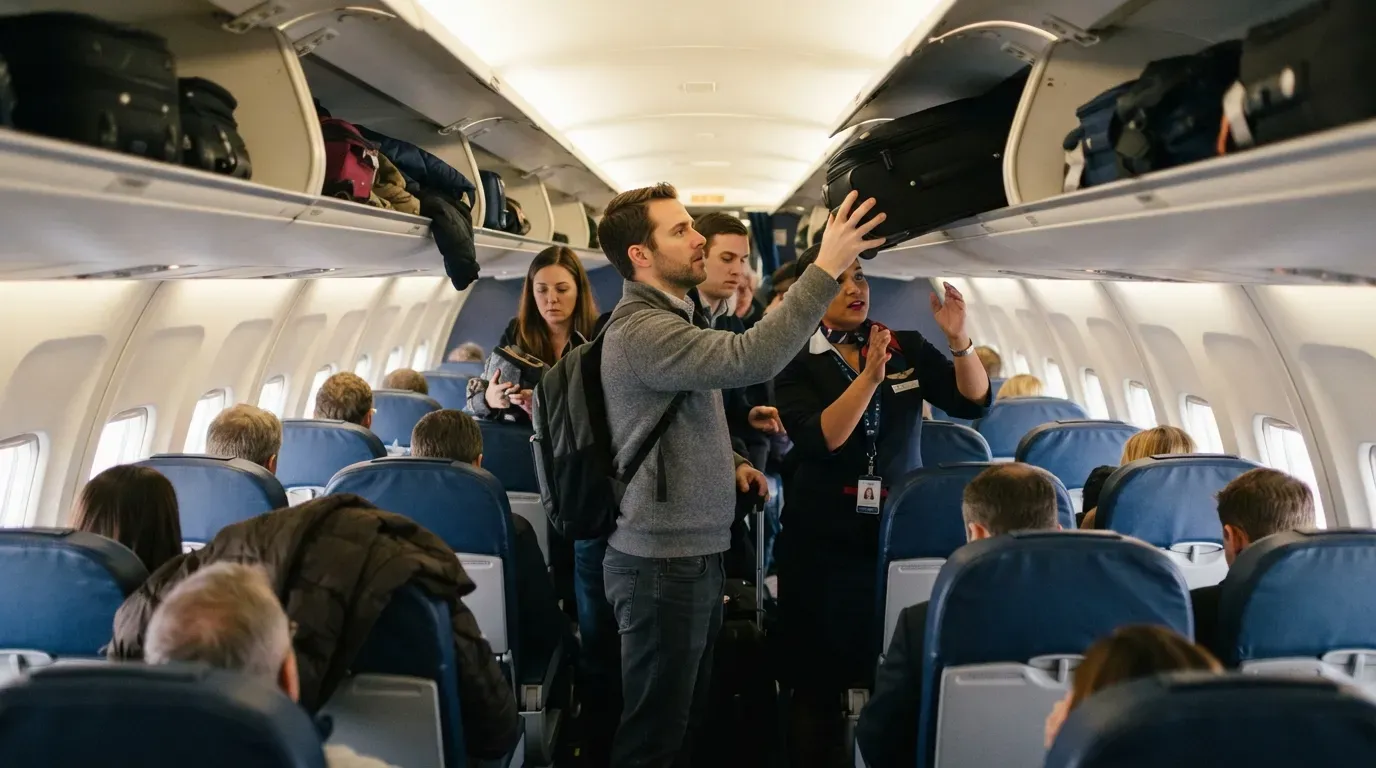
Even flyers who fully comply with an airline’s official size chart can still get burned – because the chart doesn’t always apply to the plane they’re actually on. Flying into a regional airport rather than a major hub imposes real limitations, since those airports often only accommodate smaller planes with tighter overhead spaces, meaning fewer carry-ons fit overall.
The math gets worse the smaller the aircraft gets. On regional flights operated under banners using smaller Embraer or Bombardier aircraft, the overhead bins are physically incapable of holding standard rollaboard bags, even ones that perfectly meet the airline’s official size limits. Delta Connection regional jets are a prime example – a bag that fits the standard sizer may not fit on a regional aircraft, which is why travel experts recommend always packing a personal item with essentials when a regional segment is involved.
The “Personal Item” Trick That Just Stopped Working
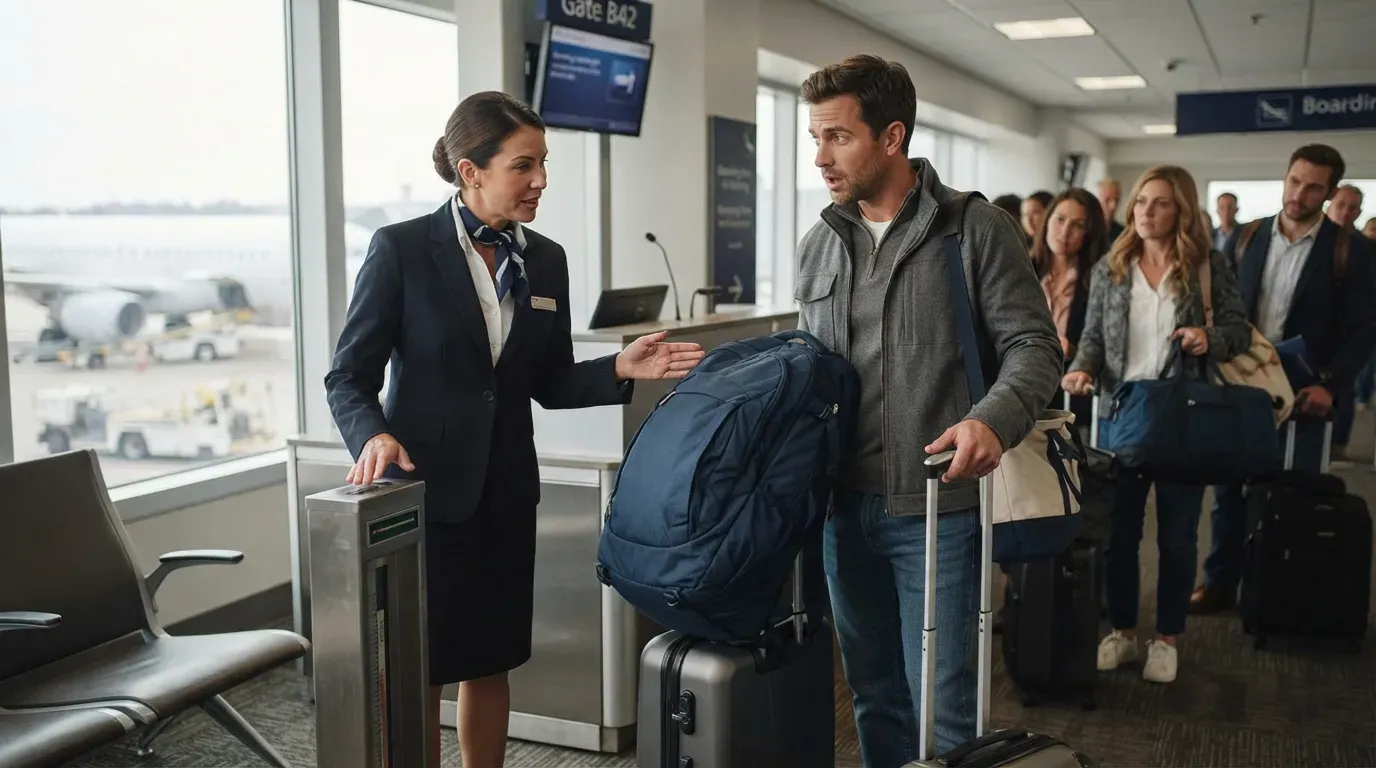
For years, savvy flyers turned the personal item allowance into a hidden second bag, stuffing oversized backpacks, roomy totes, and even small duffel bags underneath the seat and calling it a day. Airlines mostly looked away, because catching it wasn’t worth the hassle at a crowded gate.
That era is closing fast. Airlines are now closing the loophole, and gate agents check personal items more often – if a backpack is bulging, or a passenger carries more than one small bag, an agent may stop them and require combining items into one bag or paying a fee. The workaround that used to feel like a clever hack now reads, to most gate staff, as an obvious red flag.
The One Item TSA Pulls From Bags More Than Anything Else
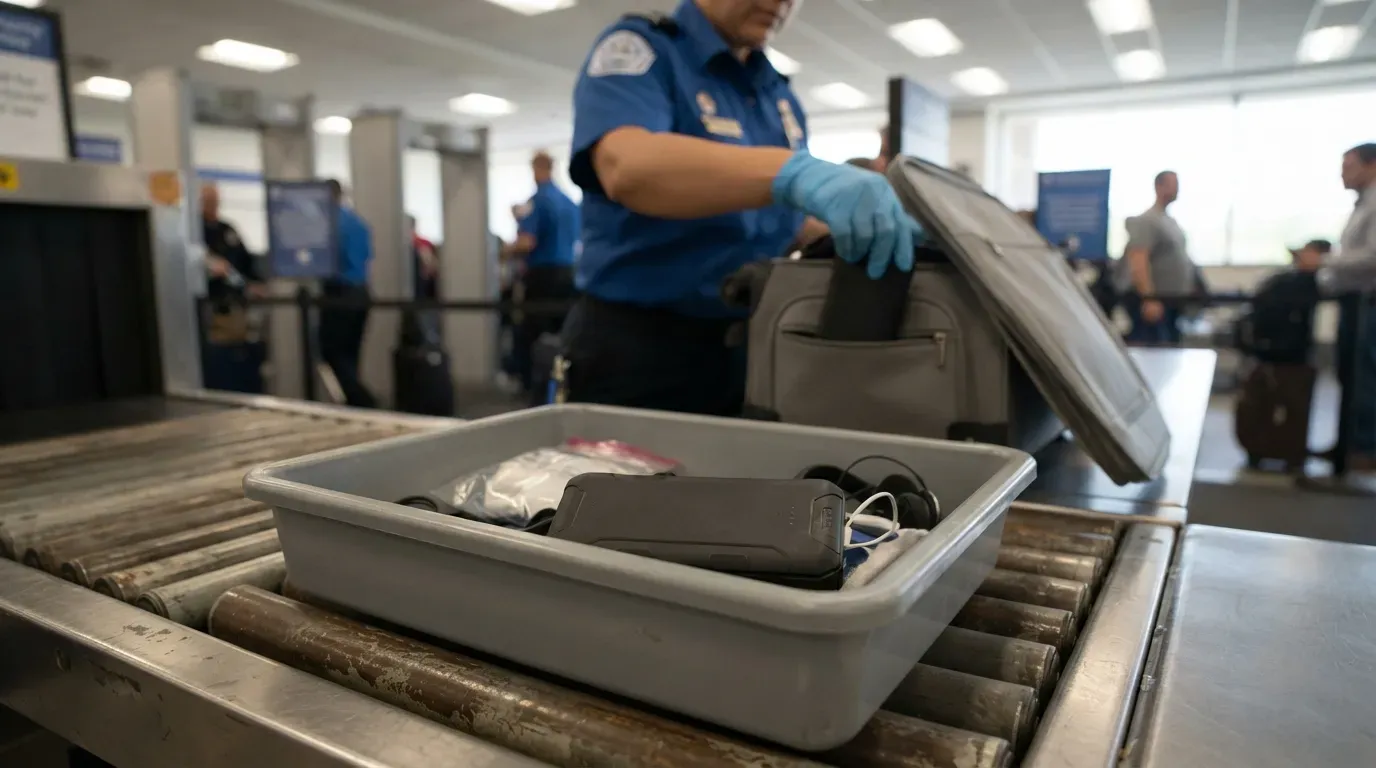
Carry-on friction doesn’t start at the gate – it starts at the security checkpoint, and the numbers there are staggering. TSA pulled 6.9 million prohibited items out of carry-on bags in 2024, a 17% jump over 2023, most of them liquids over 3.4 ounces, knives, multi-tools, and the increasingly common lithium-ion power bank exceeding the 100 watt-hour limit.
Power banks in particular have become a boarding-day headache of their own. If a carry-on contains a power bank, it must be removed before the bag is gate-checked – a bag with a power bank inside cannot go into the aircraft hold, even for a short domestic flight, and gate agents will not send it down without the battery removed. The easiest prevention is keeping the power bank in your personal item instead, since that bag never gets gate-checked and never requires a last-minute scramble.
Worth Knowing
- 6.9 million prohibited items were pulled from carry-ons in 2024 alone
- That’s a 17% jump over 2023’s totals
- Top offenders: liquids over 3.4 oz, knives, multi-tools, and oversized power banks
- Power banks over 100 watt-hours can never ride in a checked bag, even briefly
The Real Reason the FAA Suddenly Cares About Your Bag
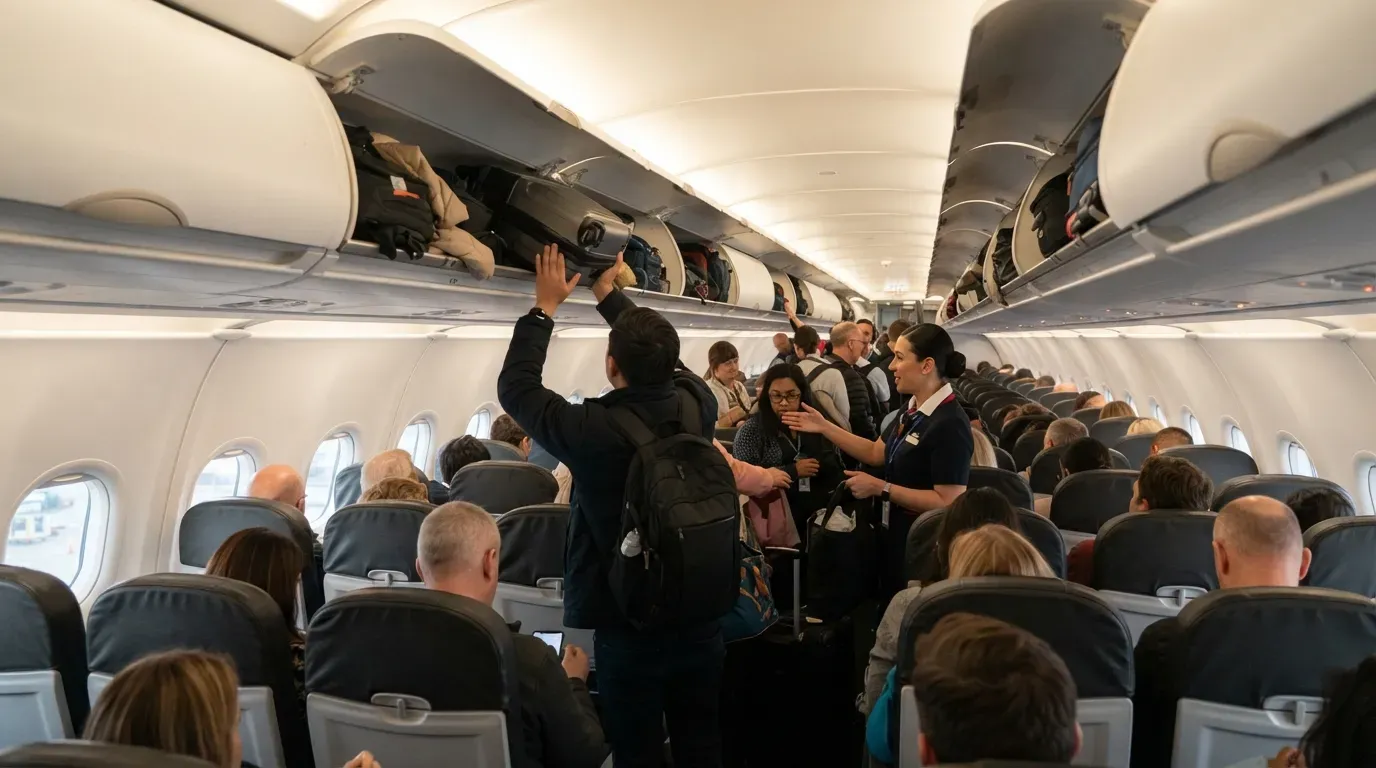
There’s a genuinely uncomfortable safety statistic behind all of this that rarely gets mentioned. Modern narrowbody jets fly fuller than at any time in commercial aviation history, with load factors across U.S. carriers averaging 84.6% in 2025 and most flights between major hubs running 92% or higher – when 180-plus passengers each bring a roller bag and a personal item, overhead bin capacity runs out about row 15.
That overcrowding isn’t just an annoyance – it’s tied directly to something regulators genuinely worry about. It cascades into a safety problem the FAA does care about: evacuation time. The federal standard requires any commercial aircraft be evacuable in 90 seconds with half the exits blocked, and passengers grabbing roller bags from overhead bins during an emergency evacuation have repeatedly delayed real-world evacuations. That’s a fact most passengers stuffing one more bag overhead have never once considered.
Why Airlines Actually Love the Chaos: It’s a $7 Billion Business
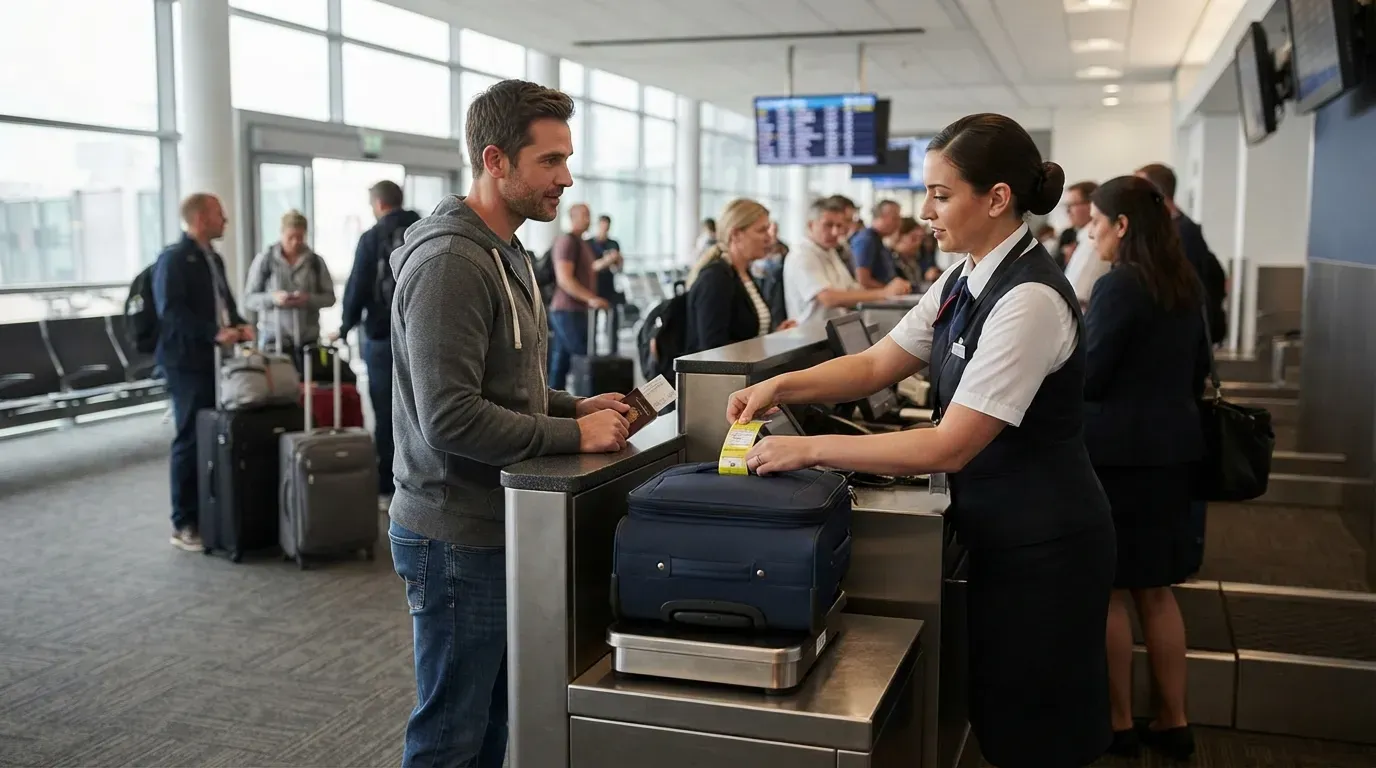
Here’s the number that explains everything else on this list. U.S. airlines earned a record $7.27 billion from baggage fees in 2024, with American ($1.5 billion), United ($1.33 billion), and Delta ($1.06 billion) leading the rankings. Ultra-low-cost carriers Frontier ($861 million) and Spirit ($774 million) generated significant baggage fee income through à la carte pricing, despite carrying far fewer passengers than the legacy giants.
Regulators have already flagged how fast this revenue stream has grown. DOT data shows airline revenue from baggage fees increased by more than 30 percent between 2018 and 2022, while operating revenue grew at less than half that pace over the same period. Every gate-checked bag that used to slide through for free is now a line item – and once you see the size of that number, “stricter enforcement” starts looking a lot less like a safety initiative and a lot more like a very quiet, very profitable business decision.
At a Glance: 2024 Baggage Fee Revenue
- American Airlines – $1.5 billion
- United Airlines – $1.33 billion
- Delta Air Lines – $1.06 billion
- Frontier – $861 million
- Spirit – $774 million
- Total U.S. industry – $7.27 billion
The Bottom Line
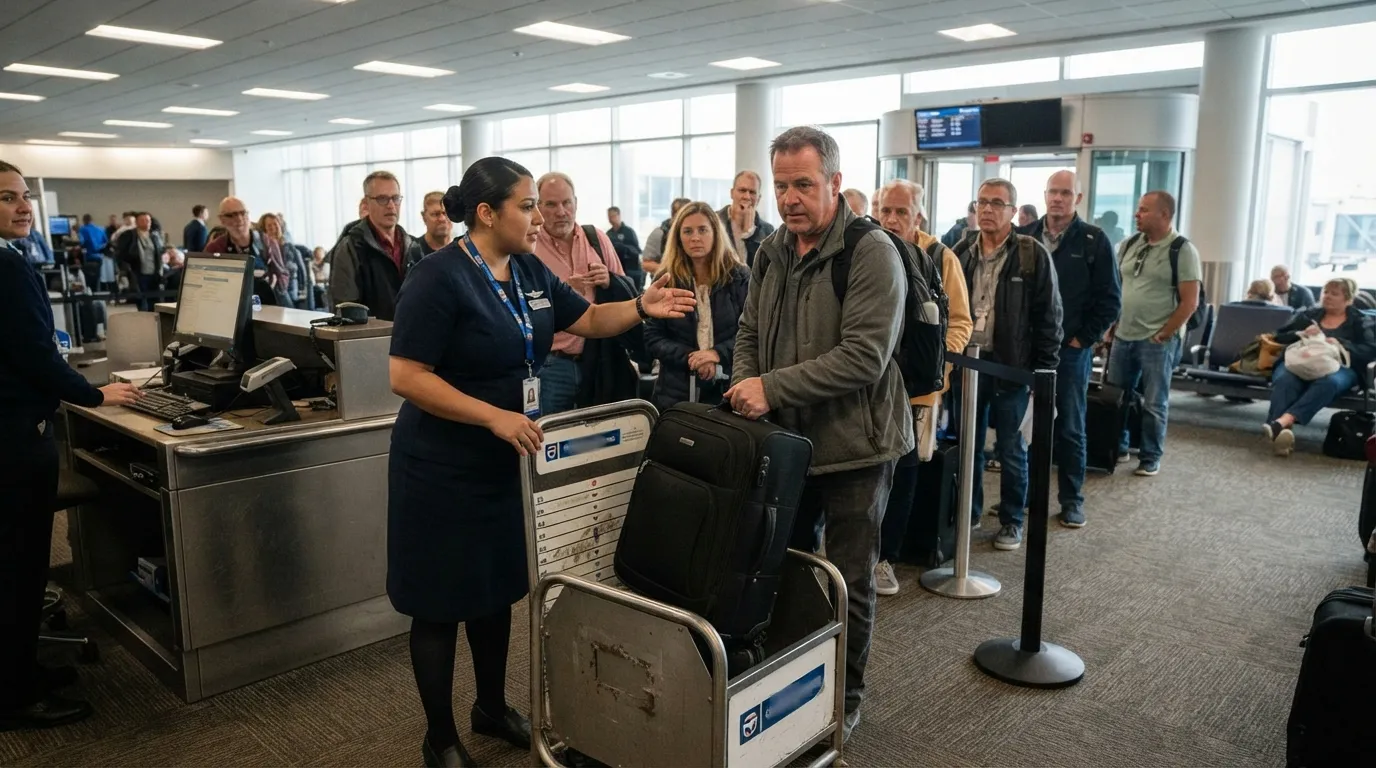
Nothing about the carry-on rule itself is new – the size chart hasn’t moved in years. What changed is enforcement: automated scanners, revived gate sizers, closed personal-item loopholes, and gate agents under real pressure to flag every borderline bag. Some of that push is genuinely about safety and evacuation timing on packed jets, but a $7.27 billion baggage-fee industry doesn’t get that big by accident.
So the next time your bag suddenly “doesn’t fit” a rule that hasn’t changed in years, you’ll know it was never really about the bag. It was about who was finally watching.